
Picture the world’s trade lanes as glowing conveyor belts stitched across the oceans. They rarely sleep, they rarely pause, and they quietly decide whether a shop shelf is full or empty, whether inflation bites or eases, whether a factory hums or falls silent. We live on a planet where “global” is not a slogan but a shipping schedule, and the steel spine of that schedule is the container ship.
Now imagine a trade line that almost never needs to stop.
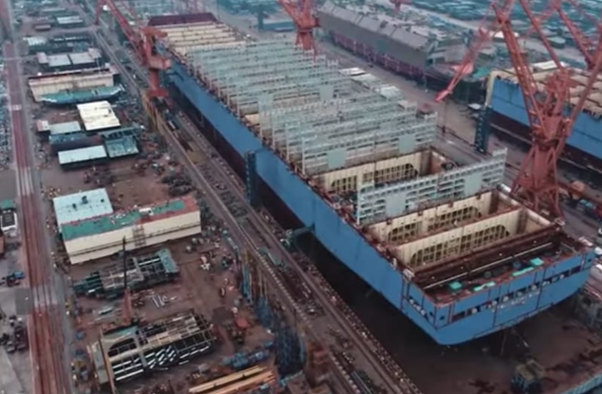
In late 2025, reports began circulating that China is developing a 14,000 TEU nuclear-powered container ship concept based on a thorium molten-salt reactor. The scale is the headline-grabber: roughly 400 metres in length on paper, placing it in the realm of the world’s largest box ships, and sized to carry the kind of cargo volume that keeps entire retail seasons alive. The idea, as described, is not a naval vessel wearing civilian clothing. It is a merchant ship designed to haul containers like any other, just with its “engine room” replaced by a compact nuclear heat source feeding electric propulsion.
This matters because shipping is both invisible and enormous. Around 80% of global trade by volume moves by sea, and the industry’s emissions sit in the uncomfortable neighbourhood of about 3% of global greenhouse gases. In other words, the ships that make modern life convenient also help make the atmosphere unstable.
A floating power station, but built for commerce
Traditional large container ships burn heavy fuel oils or marine fuels that, even with tightening regulation, remain carbon intensive. Fuel can dominate operating costs and makes shipping vulnerable to price spikes and geopolitical turbulence. If you can remove the need for constant bunkering, you don’t just reduce emissions, you rearrange the chessboard of logistics: fewer dependency points, fewer refuelling constraints, different route economics, different risk maps.
The thorium concept aims straight at that pressure point. Instead of diesel turning a propeller shaft, the ship would use nuclear heat to generate electricity and drive electric motors. The “thorium” detail is what turns this from familiar nuclear propulsion into something more novel. Thorium (typically thorium-232) isn’t the direct fissile fuel, but it can be used in fuel cycles that breed uranium-233 under neutron exposure, which then sustains fission in appropriate reactor designs. The Chinese narrative gained extra credibility when industry watchers pointed to progress on a molten-salt reactor programme and reported milestones around thorium fuel-cycle work.
And molten-salt reactors, at least in theory and in various experimental efforts, come with an alluring promise: high-temperature operation, strong passive safety characteristics, and the possibility of designs that behave more gracefully under fault conditions than the public’s mental image of nuclear power. One of the often-cited safety ideas is that certain molten-salt designs can be engineered so that, if overheated, the fuel drains away from the reaction zone into a passively cooled configuration, reducing the risk of runaway heat. Whether any shipping reactor achieves that in real-world maritime conditions is the kind of detail that separates a concept sketch from a class-approved ship. But the direction of travel is clear: nuclear designers are trying to make “safe by physics” a selling point rather than a footnote.
Why thorium, and why China, and why now?
Thorium is frequently described as more abundant than uranium, and it’s geographically widespread. From a strategic perspective, a nation that can source its own reactor materials and master its own fuel-cycle processes reduces vulnerability to import dependence. That theme appears repeatedly in coverage of China’s interest in thorium-based systems and related fuel-cycle experiments.
Then there’s the industrial reality: China is already a shipbuilding superpower. If a country with immense yard capacity, state-backed financing, and a hunger for technological leverage decides to push a new propulsion standard, the world notices.
But the strongest reason for “why now” is simpler: the old bargain is expiring. The maritime sector is under mounting decarbonisation pressure, and it’s experimenting with alternatives like methanol, ammonia, LNG, and efficiency measures. Reuters has covered how “cleaner-fuel capable” ship orders remain a significant slice of newbuild demand, and how major carriers are actively trialling fuel blends and pathways as regulations tighten and carbon costs loom.
In that context, nuclear propulsion becomes the ultimate wager: a high-capex leap that could offer near-zero operational emissions and stable “fuel” economics, but only if regulation, insurance, port access, and public acceptance can be made to line up like dominoes.
The ghosts of nuclear shipping past
This is not humanity’s first attempt at a nuclear merchant ship. The Soviet-built Sevmorput stands as a rare surviving example of a nuclear-powered cargo vessel, and its history illustrates the challenge: technical achievement is not the same as commercial adoption. Nuclear merchant ships have existed, but they remained the exception rather than the rule, partly due to cost, complexity, and politics.
And politics matters here in a very practical sense. Many ports have strict controls or outright resistance to nuclear-powered civilian vessels. Even if the engineering is brilliant, a ship that can’t enter key ports without lengthy negotiations (or can’t be insured at workable rates) is not a revolution, it’s a curiosity.
The real bottleneck: trust, law, and the “what if”
Every conversation about nuclear ships eventually arrives at the same hard question: What happens if something goes wrong at sea? A fire. A collision. A grounding. A sinking. The ocean is not a laboratory bench. It is a moving, violent world that treats human confidence as a snack.
This is where proponents point to molten-salt safety characteristics and compact reactor modules, and critics point to legal frameworks that are not yet harmonised for widespread nuclear commercial fleets. The gap between those two points is filled with insurers, regulators, classification societies, coast guards, and the court of public opinion. It’s a crowded room, and every person in it has veto power.
Yet the pressure pushing from behind is also real. If shipping is about three percent of global emissions, and if the world is genuinely serious about bending the curve, then shipping must change. The sector is “hard to abate”, as development and policy institutions regularly note, because ships travel long distances and can’t simply plug into a socket mid-Pacific.
So, the future may not belong to one solution. It may belong to a messy portfolio: green fuels for some routes, wind-assist and efficiency for others, electrification at ports, smarter logistics, and perhaps, for a certain class of ultra-large long-haul vessels, nuclear propulsion if it can be made socially and legally acceptable.
A slightly philosophical ending, with salt on it
There’s an irony here worth tasting. Containers made the world smaller. They turned oceans into highways and distance into a rounding error. Now the world wants those highways to be cleaner, quieter, and less hostage to fossil fuel volatility. Nuclear power, the technology most associated with fear and secrecy, is being pitched as a tool for predictability and decarbonisation.
If China’s thorium-powered cargo ship remains a concept, it still tells us something important: the shipping industry is entering its “reinvention decade”. If it becomes real, it could force every major maritime nation to decide what it believes about risk, climate, and competition, and to do so faster than bureaucracies usually like.
Either way, a new question is drifting into view on the horizon: not only how we move goods, but what kind of world we are building while we move them.
Johan West is a climate change consultant and the Managing Director of GreenAfricaEnergy .