
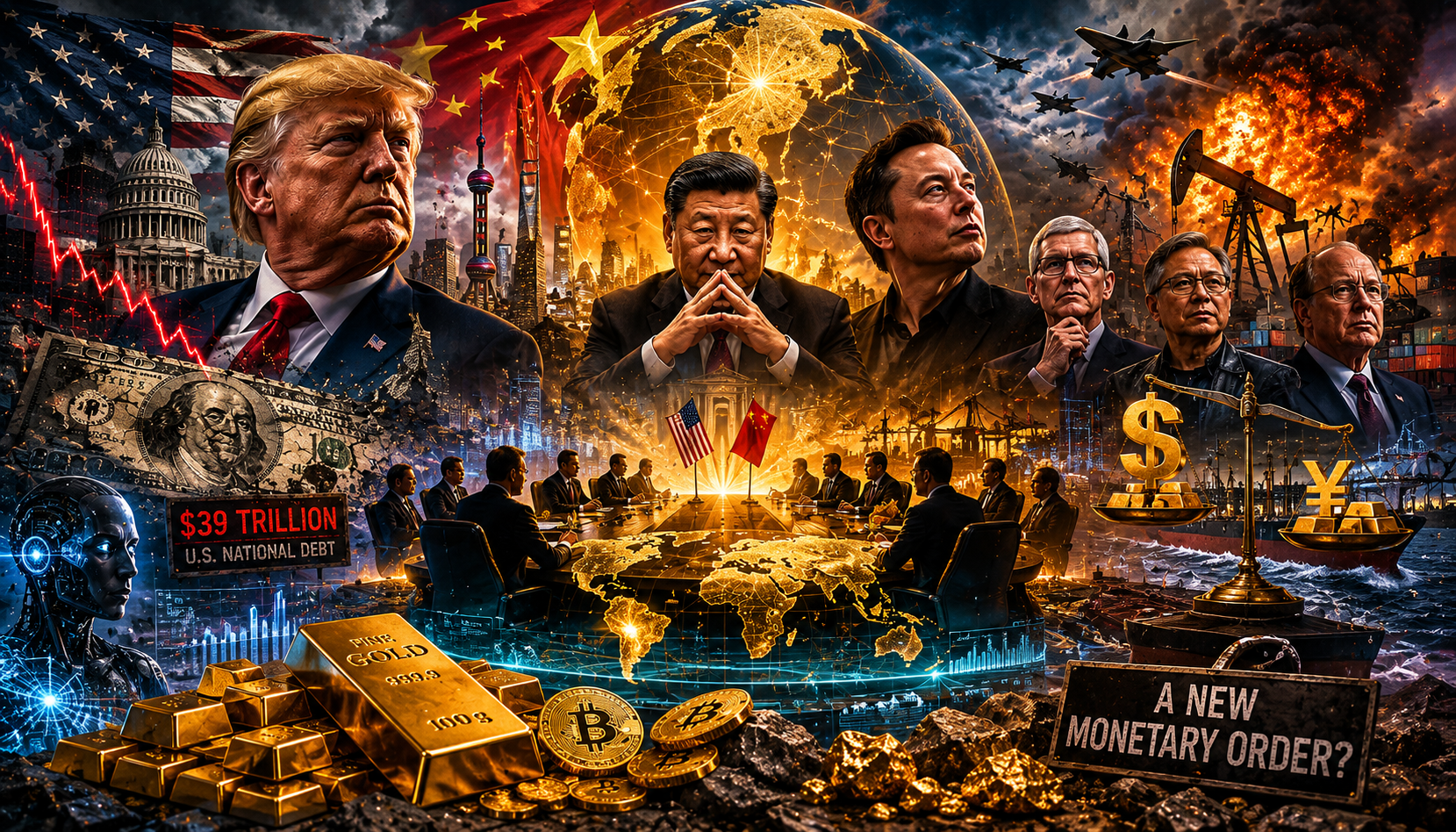
Chapter 4: Trump, China and the Search for a New Monetary Order
As the debt crisis deepens and the pressure on the American financial system intensifies, an increasingly important question begins to emerge behind the scenes of global politics and economics: what exactly is America’s plan to escape this trap?
Governments rarely announce the real negotiations shaping the future of the world economy. History shows that the most important monetary restructurings are usually discussed quietly, behind closed doors, long before the public fully understands what is taking place. That is why one particular event raised eyebrows across the financial world: Donald Trump travelling to China accompanied by an extraordinary delegation of corporate power, including figures such as Elon Musk, Tim Cook, Jensen Huang and Larry Fink of BlackRock. It was arguably one of the most powerful collections of American business leadership ever assembled for a foreign visit.
Officially, the meetings focused on trade, diplomacy and geopolitical stability. But there is a growing theory that something much larger may have been discussed behind the scenes. According to this theory, the discussions were not simply about tariffs or manufacturing agreements. They may have represented the early outlines of a new global monetary restructuring, potentially one of the most significant financial transitions since the end of the Second World War.
To understand why this theory is gaining attention, one must revisit an event from 1985 known as the Plaza Accord.
At the time, the United States faced problems that sound remarkably familiar today. America had a large trade deficit, the dollar had become too strong, and US manufacturing was struggling to compete globally. In response, the Reagan administration convened a secretive meeting at the Plaza Hotel in New York with France, West Germany, Japan and the United Kingdom. The agreement they reached effectively weakened the US dollar, particularly against the Japanese yen.
The consequences were enormous.
The Japanese yen doubled in value against the dollar in a relatively short period. Japanese exports suddenly became far more expensive, while American goods became comparatively cheaper. The US trade imbalance improved and American manufacturing regained competitiveness. In exchange, Japan was allowed to invest heavily into the United States. Japanese companies such as Toyota, Honda and Nissan began building factories in America, while Japanese capital flooded into US real estate, Treasury bonds and businesses.
Initially, it appeared that everybody won.
But Japan paid a devastating long-term price.
Because the Japanese economy was heavily export-driven, the rapid currency revaluation damaged competitiveness. Japan attempted to offset the damage by flooding its economy with cheap money, which created one of the largest asset bubbles in modern history. Real estate and stock markets exploded into speculative excess. When the bubble eventually burst, Japan entered what became known as the “Lost Decades,” a period of stagnation and deflation from which it never fully recovered.
China studied that lesson carefully.
This is where the modern theory becomes fascinating. The argument is that China understands exactly what happened to Japan and has no intention of allowing the yuan to suffer the same fate. Instead of directly revaluing the Chinese currency against the dollar, the restructuring could occur through another mechanism entirely: gold.
According to this theory, the negotiations between Washington and Beijing may involve a modernised version of the Plaza Accord, but with gold acting as the balancing mechanism rather than direct currency revaluation.
The geopolitical backdrop makes this theory even more intriguing. Chinese President Xi Jinping openly referenced what political scientists call the “Thucydides Trap,” a theory based on the ancient Greek historian Thucydides, who observed that when a rising power threatens an existing dominant power, war often follows. Historical studies have identified sixteen major cases of rising powers challenging established powers, with twelve of them ending in war.
China and the United States both understand this historical pattern.
The implication is clear: both sides know that direct confrontation could become catastrophic, particularly in a world already carrying unprecedented levels of debt and geopolitical tension. Therefore, a financial restructuring may be preferable to military escalation.
At the same time, the world’s energy system has become deeply unstable. The Strait of Hormuz, through which roughly 20% of the world’s oil supply flows, has become one of the critical pressure points in the global economy. The closure and disruption associated with the Iran conflict have reportedly forced the world to draw heavily on emergency oil reserves. Global inventories have been steadily declining, while analysts warn that operational minimum levels for pipelines and refineries could eventually be tested.
The official narrative has repeatedly suggested that the crisis would be temporary and quickly resolved, yet the underlying data appears more troubling. Oil deficits persist, inventories continue falling, and major energy executives from companies such as Chevron, ConocoPhillips and Saudi Aramco have publicly expressed concerns about tightening supply conditions.
What makes this particularly dangerous is that oil prices have not yet fully reflected the severity of the underlying stress. Some analysts argue that financial markets, paper oil trading and media narratives may be artificially suppressing volatility in order to buy time for the global financial system.
This leads to another controversial aspect of the theory: that Iran may be functioning less as an isolated rogue actor and more as a strategic pressure point within a broader geopolitical contest involving China and Russia. The argument suggests that the prolonged disruption of energy flows gives China and Russia significant leverage over the West without requiring direct military confrontation.
In this context, the Trump-China negotiations begin to look less like ordinary trade talks and more like the early stages of a systemic financial negotiation.
At the heart of this theory lies one central idea: the United States may eventually need to devalue the dollar in order to survive its debt burden, but it cannot afford to do so openly.
This is where gold enters the picture.
Chapter 5: Gold, Debt and the Hidden Repricing of the Dollar
Officially, the United States government holds more than 8,000 tons of gold reserves. Yet on government balance sheets, that gold is still valued at approximately $42 per ounce, a figure dating back to the early 1970s. Meanwhile, the actual market value of gold has exploded far beyond that level.
If gold were officially repriced closer to market levels, the US balance sheet would instantly appear dramatically stronger. The government’s asset side would surge in value without printing new gold or discovering new reserves. In effect, the debt burden would become relatively smaller when measured against a much larger gold-backed asset base.
China, meanwhile, has spent years aggressively accumulating gold reserves. The exact size of China’s gold holdings remains uncertain, but there is little doubt that Beijing has been strategically increasing its exposure to physical gold for a long time.
An especially interesting development is that, in recent years, gold exports from the United States have reportedly surged. In fact, for several recent months, non-monetary gold became one of the largest American exports, exceeding industries such as oil, pharmaceuticals and aircraft engines. Much of this gold reportedly moved first through Switzerland before ultimately heading toward China.
Historically, gold flows have often signalled shifts in global financial power. As the British Empire declined in the early twentieth century, gold increasingly flowed from London to New York. By the end of the Second World War, the United States controlled more than half of the world’s gold reserves, helping cement the dollar’s status as the world’s reserve currency under the Bretton Woods system.
The old rule of history appears remarkably consistent: the country importing gold tends to gain influence, while the country exporting gold tends to lose it.
This does not necessarily mean America is collapsing or that China is about to dominate the world financially overnight. But it does suggest that a major monetary transition may already be underway beneath the surface.
According to the theory, the proposed deal between America and China may involve a coordinated weakening of the dollar against gold rather than against the yuan directly. This would allow China to avoid the catastrophic currency appreciation that damaged Japan after the Plaza Accord, while simultaneously increasing the value of both American and Chinese gold reserves.
At the same time, China could flood America with investment capital. Reports have already circulated suggesting that China may be prepared to invest as much as $1 trillion into US manufacturing, industrial infrastructure and supply chains. Chinese-owned factories operating inside the United States could potentially gain tariff relief and improved market access.
For America, this would help rebuild manufacturing capacity and create jobs. For China, it would preserve access to the world’s largest consumer market while securing a seat at the table during the restructuring of the global monetary order.
The irony would be extraordinary: America rebuilding its industrial base with Chinese money while simultaneously weakening the dollar against gold to manage its debt crisis.
This would also explain certain unusual market movements. Despite geopolitical tensions and conflict rhetoric, the Chinese yuan has at times strengthened rather than weakened. Chinese government borrowing costs have remained relatively stable while yields in many Western countries continue rising. Gold prices have surged aggressively. Bond markets have shown signs of stress. Smart money appears to be positioning itself for some form of monetary transition long before any official announcement.
Whether the full theory is correct remains uncertain. But the fingerprints of a potential restructuring are increasingly difficult to ignore.
Chapter 6: Inflation, Artificial Intelligence and the Coming K-Shaped Society
If this theory proves even partially correct, the consequences for ordinary people could be profound.
The key mechanism underpinning the entire transition is inflation.
Modern governments rarely default outright because default destroys confidence. Instead, they often attempt to inflate debt away gradually. A trillion dollars borrowed years ago becomes easier to repay if the purchasing power of the currency itself declines over time.
In simple terms, inflation quietly reduces the real value of debt.
But inflation does not affect everyone equally.
Those who own assets such as shares, real estate, gold, scarce collectibles, businesses or even digital assets often see the nominal value of their holdings rise during inflationary periods. Their wealth is protected or even enhanced.
Those who rely primarily on salaries, savings accounts or fixed incomes suffer the opposite effect. Food becomes more expensive. Fuel rises. Housing costs increase. Rent climbs. Insurance rises. Electricity becomes more costly. Yet wages often fail to keep pace.
This creates what economists increasingly describe as a K-shaped economy. One part of society rises upward with asset inflation and technological productivity gains, while another part falls behind under the pressure of inflation, debt and job displacement.
Artificial intelligence may dramatically accelerate this divide.
The AI revolution is likely to increase productivity, automate large parts of the economy and create extraordinary wealth for certain sectors. But it may also eliminate millions of traditional jobs across customer service, administration, manufacturing, logistics, warehousing, transport and routine office work.
Society therefore faces a dangerous combination: rising inflation, growing wealth inequality and accelerating technological disruption occurring simultaneously.
Historically, such transitions often produce social instability. Declining trust in institutions, anger, protests, political extremism and cultural fragmentation tend to emerge when large parts of the population feel economically trapped while another segment accumulates enormous wealth.
At the same time, governments and financial institutions are rapidly developing digital financial infrastructure. Central bank digital currencies, digital identification systems, programmable money and increasingly algorithmic financial controls are all being discussed or tested across the world.
Supporters describe these systems as financial innovation and efficiency. Critics warn that they may evolve into highly centralised systems of economic control, particularly during periods of instability.
Whether one views these developments as necessary modernisation or as the construction of a digital control grid depends largely on one’s perspective. But there is little doubt that the financial architecture of the future will be far more digital, far more integrated and potentially far more centralised than the world most people grew up in.
Yet even within all this uncertainty, one truth continues to emerge.
The current global financial system cannot continue indefinitely in its present form. The debt burdens are too large. The geopolitical tensions are too severe. The energy system is too fragile. The technological disruption is too rapid.
Something will eventually adjust.
Perhaps the theory surrounding a gold-based restructuring is wrong. Perhaps the Strait of Hormuz reopens fully tomorrow. Perhaps inflation is absorbed differently than expected. Perhaps technological innovation creates new productivity growth strong enough to stabilise the system.
But regardless of the exact path, the direction appears increasingly clear: the dollar will likely lose purchasing power over time, debt will be inflated gradually, asset ownership will become increasingly important, and the global financial system will continue moving toward a more digitised and centralised structure.
The world is not necessarily approaching the end of civilisation. But it may very well be approaching the end of one monetary era and the uncertain birth of another.