
Chapter 1: America’s $39 Trillion Warning Signal
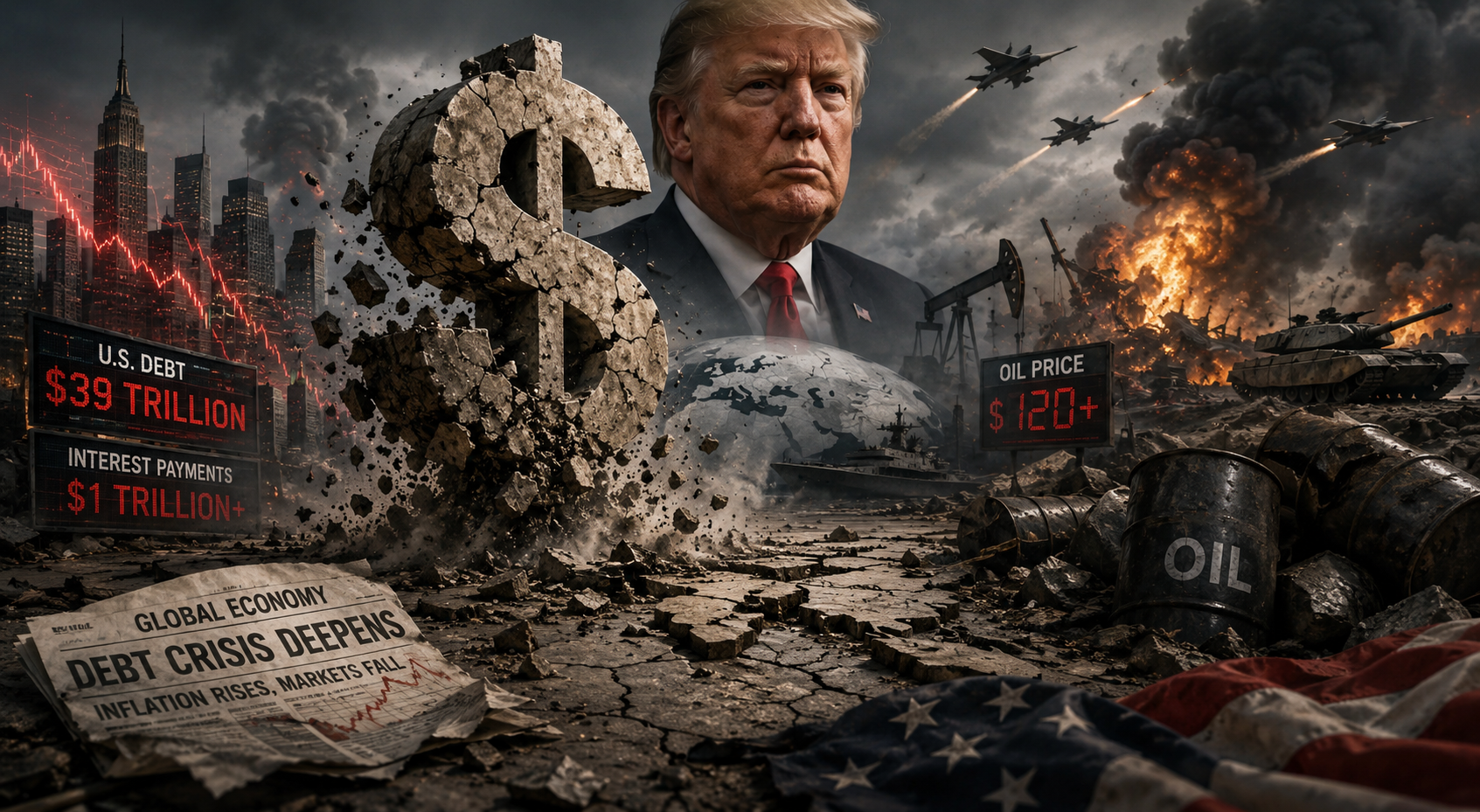
The United States has now crossed a psychological and financial threshold that should make the entire world pause. Its national debt has reached approximately $39 trillion. More specifically, the US gross federal debt was recently recorded at around $38.91 trillion, of which roughly $31.26 trillion was debt held by the public and about $7.65 trillion was intragovernmental debt. Even more alarming is the pace at which this mountain is growing. Over the previous year, it was increasing at approximately $7.39 billion per day.
That figure is almost impossible to absorb. It means that while ordinary people argue about household budgets, fuel prices and grocery bills, the world’s most important economy is adding billions of dollars of debt every single day. The problem is not simply that America owes a lot of money. The deeper problem is that the debt is rising faster than the political system appears willing or able to control.
America is not like a normal country. It borrows in its own currency. It issues the world’s main reserve currency. Its Treasury market is the backbone of global finance. US government debt is not merely an American instrument; it is used as collateral, reserve asset, safe haven and benchmark across the entire world. Banks, pension funds, governments, sovereign wealth funds and central banks all rely on the assumption that US debt is safe, liquid and unquestionable.
That is why this issue is so serious. If America were just another indebted country, the matter would be mostly domestic. But because America is the financial anchor of the global system, its debt trajectory becomes a planetary concern.
The most worrying part is not even the headline debt number. It is the interest bill. Net interest payments were already around $970 billion in 2025 and are projected to rise to more than $1 trillion in 2026. By 2036, interest costs are projected to reach approximately $2.1 trillion. In plain language, America is moving toward a future where the cost of servicing yesterday’s debt becomes one of the largest items in tomorrow’s budget.
This creates a dangerous fiscal loop. The government borrows more, which increases the debt. The larger debt requires larger interest payments. Larger interest payments widen the deficit. The wider deficit requires more borrowing. More borrowing increases the debt again. Eventually, the snake begins to eat its own tail.
Current projections suggest that US debt held by the public could rise from about 101% of GDP in 2026 to around 120% of GDP by 2036. Deficits are also expected to remain historically large, rising from around $1.9 trillion in 2026 to approximately $3.1 trillion by 2036. These numbers are not wartime emergency numbers. They are becoming the baseline.
This is the real warning sign. A country can borrow heavily during a crisis and recover if growth returns strongly afterwards. But when huge deficits become normal during ordinary times, the system becomes fragile. It loses flexibility. It becomes harder to respond to war, recession, banking shocks, pandemics, disasters or energy crises.
The United States is not likely to collapse tomorrow. It is not Argentina. It is not Greece. It has the dollar, the Federal Reserve, deep capital markets, unmatched military reach, vast technological power, enormous agricultural capacity and extraordinary innovation. But none of that means the debt path is harmless.
The more realistic danger is not an immediate explosion. It is slow fiscal strangulation. Interest costs begin to crowd out other priorities. Defence, healthcare, pensions, infrastructure, disaster relief and social programmes all compete with the bond market. The government does not run out of money in the normal sense. It runs out of room.
That is how empires weaken. Not always through one dramatic collapse, but through a long period where every decision becomes more expensive, every shock becomes harder to absorb, and every compromise becomes politically poisonous.
Chapter 2: Oil, China, War and the Fragile Global Machine
The American debt problem cannot be understood in isolation. It is part of a larger global machine that is already under pressure from energy instability, war risk, demographic decline, weak growth and geopolitical fragmentation.
Oil is one of the great pressure points. High oil prices are complicated for the United States. On one side, America is now a massive energy producer. US crude oil production reached a record of about 13.6 million barrels per day in 2025. This gives America an advantage that many other countries do not have. When oil prices rise, US energy companies benefit. Shale producers, exporters and oil-producing states receive a boost. In that narrow sense, higher oil prices can support parts of the American economy.
But the broader effect is far more dangerous. Expensive oil is a tax on everything.
It raises the cost of transport, food, fertiliser, plastics, aviation, shipping, manufacturing and construction. Once oil rises, the increase does not stay politely inside the petrol pump. It leaks into every shelf, every invoice and every meal. Inflation becomes harder to control. Consumers become more indebted. Businesses face higher input costs. Central banks are forced to keep interest rates higher for longer. Higher interest rates then make government debt more expensive to service.
So while high oil prices may enrich one part of America, they weaken another. They help the producer but punish the household. They support Texas but hurt the consumer. They boost energy profits but raise inflation. And in a debt-heavy world, inflation and high interest rates are especially dangerous.
This is why a wider Middle East conflict, a China-Taiwan war, a major cyberattack, another pandemic or even an extreme natural disaster could become far more than an isolated crisis. It could become the spark that ignites the debt structure beneath the global economy.
Even a smaller war now costs billions. A larger war involving a major power would cost hundreds of billions, perhaps trillions. If America were forced into a major Taiwan conflict, a wider Middle East war, or a simultaneous global security emergency, it would have to borrow massively at precisely the moment markets may already be worried about its fiscal position.
That is when the bond market becomes the battlefield behind the battlefield.
China does not offer a simple alternative. Many people assume that if America weakens, China automatically rises to replace it. But China has its own enormous structural problems. Its economy is slowing. Its property sector remains deeply stressed. Local government debt is heavy. Its population is aging. Consumer demand is weaker than Beijing would like. Deflationary pressure remains a concern. Growth projections have already slowed, with Chinese growth expected around 4.5% in 2026.
China is powerful, industrial and strategic, but it is not a clean replacement for the American-led financial order. It does not yet offer the same trusted reserve currency, legal transparency, capital-market depth or global financial openness that the dollar system provides.
Europe is also not strong enough to carry the world. It has deep institutional capacity and wealthy economies, but it is aging, politically fragmented, energy vulnerable and struggling with competitiveness. Russia has energy, minerals and military resilience, but it does not have the economic depth or financial infrastructure to replace America. Emerging markets are dynamic, but many are vulnerable to dollar strength, high interest rates and capital flight.
The world is therefore not moving neatly from one empire to another. It is moving into a messy multipolar era where all the major centres of power are under strain at the same time.
This is what makes the present moment so dangerous. The global economy was built on assumptions of cheap capital, expanding globalisation, relatively stable energy, growing trade and confidence in government bonds as safe assets. Each of those assumptions is now being challenged.
If America sneezes, the world still gets flu. But this time the world’s immune system is already weakened.
South Africa and other emerging economies would not be spectators in such a crisis. They would feel it through the Rand, fuel prices, food inflation, interest rates, borrowing costs, foreign investment flows and commodity demand. A stronger dollar and higher US yields usually pull capital away from riskier markets. That weakens currencies like the rand. A weaker rand makes imported fuel, machinery, technology and fertiliser more expensive. Food prices rise. Consumers suffer. Government debt becomes harder to manage. Businesses delay investment. Poverty deepens.
This is the cruel truth of global finance. The countries least responsible for the architecture of the system often suffer heavily when that system shakes.
Chapter 3: The Coming Reset and the Future of the Global Financial System
The most important question is whether the United States can simply reset the system. Could a president declare a default? Could America move to Bitcoin? Could it create a new stablecoin-based monetary order? Could it inflate the debt away? Could it restructure without calling it a default?
In theory, America has many tools. In practice, each tool carries enormous risk.
A US president cannot simply wake up and cancel the debt without consequences. US debt obligations are created through Congress, the Treasury, law, markets and constitutional structures. The validity of US public debt is deeply embedded in the legal and political system. A formal default would not be a neat administrative decision. It would create a constitutional crisis, a market crisis, a banking crisis and a geopolitical crisis all at once.
More likely, America will avoid an explicit default and instead pursue softer forms of adjustment.
The first method is inflation. If inflation runs higher than interest rates over time, the real value of debt is slowly eroded. Savers lose purchasing power, but the government’s debt burden becomes easier to manage in real terms. This is politically easier than admitting to default, but it is still a form of silent wealth transfer.
The second method is financial repression. Governments can encourage or require banks, pension funds, insurers and financial institutions to hold more government debt. This creates built-in demand for Treasury bonds. It keeps the system functioning, but it also traps savings inside the government financing machine.
The third method is taxation. The US may eventually have to raise revenue through higher taxes, closing loopholes, wealth-related measures, corporate tax reforms or consumption-based taxes. Politically, this will be extremely difficult.
The fourth method is spending reform. This may include entitlement reform, defence procurement reform, healthcare cost control and slower growth in federal programmes. Again, politically painful.
The fifth method is monetary transformation. This is where the future becomes particularly interesting.
The world is unlikely to see Bitcoin simply replace the US dollar as the main global monetary system. Governments do not willingly surrender control over money to something they cannot issue, tax, regulate or manipulate. Bitcoin may become more important as a hedge against fiat currency weakness, but it is unlikely to become the official operating system of global finance.
A more likely future is the rise of regulated digital money: tokenised Treasuries, central bank digital currencies, regulated stablecoins and digital dollar infrastructure. Stablecoins backed by US Treasuries could create new global demand for American debt. Tokenised government bonds could make Treasury markets faster, deeper and more integrated into digital finance. The dollar system may not disappear; it may mutate into a digital version of itself.
That may buy time, but it does not solve the underlying fiscal problem. Technology can improve plumbing, but it cannot permanently defeat mathematics.
The real solution requires a new global compact. Something approaching a modern Bretton Woods moment may eventually become necessary. Not necessarily a single grand conference with flags and speeches, but a coordinated restructuring of global assumptions around debt, energy, currency stability and development finance.
The United States would need to adopt a credible 10-year fiscal stabilisation plan. Not reckless austerity, but disciplined reform. The goal should be to stabilise debt before markets force a disorderly adjustment. That means slowing the growth of spending, reforming inefficient programmes, improving tax collection, closing wasteful loopholes, controlling healthcare costs, and creating a believable path where debt no longer rises endlessly relative to GDP.
Emerging markets would need a stronger debt-relief and restructuring framework. Many developing countries cannot survive a world of high dollar interest rates, high oil prices, climate damage and weak currencies without support. The IMF, World Bank, China, Gulf sovereign funds, Western lenders and private creditors would need to cooperate more effectively. Debt restructuring must become faster, more transparent and less destructive.
Energy security must become monetary security. This is one of the most important lessons of the present moment. Countries that rely heavily on imported fuel are financially vulnerable. Oil shocks become inflation shocks. Inflation shocks become interest-rate shocks. Interest-rate shocks become debt shocks. Therefore, investment in renewable energy, grid infrastructure, storage, rail logistics, local food production and fertiliser resilience is not merely environmental policy. It is financial defence.
For South Africa, this is especially important. A global debt crisis would likely weaken the rand, raise fuel prices, increase food inflation and make foreign borrowing more expensive. The country must therefore build resilience before the storm arrives. That means reducing unnecessary dollar exposure, strengthening local energy supply, improving port and rail efficiency, supporting export sectors, building food-security systems, attracting long-term productive investment and avoiding dependence on short-term speculative capital.
The timing matters. The window for orderly action is probably 2026 to 2030. During this period, the world still has enough time to stabilise expectations, reform fiscal pathways and build energy resilience. After 2030, the pressure may become much harder to manage. By 2036, if US debt has moved toward 120% of GDP, deficits are around $3.1 trillion, and interest costs are around $2.1 trillion, the system may already be in forced adjustment mode.
The next global financial crisis may not begin in banks. It may begin in government bond markets.
That would be a profound shift. For decades, sovereign bonds were treated as the foundation of safety. They were the anchor. They were the place investors ran to when fear entered the room. But if government balance sheets themselves become the source of doubt, the world enters a very different era.
The old safe asset could become the new fault line. This does not mean the world will end. It does mean the world financial system will change. The likely future is not one dramatic collapse, but a series of adjustments: higher inflation tolerance, more digital money, more government intervention, more pressure on savers, more currency volatility, more geopolitical bargaining and more competition between financial blocs.
America will probably not collapse first. It will mutate first. The dollar may remain dominant, but in a more controlled, digitised and politically contested form. China will continue trying to reduce dependence on the dollar, but it will struggle to replace it completely. Europe will seek strategic autonomy, but will remain constrained by internal divisions. Emerging markets will try to diversify, but many will remain vulnerable to dollar cycles. Countries with food, energy, minerals, water, infrastructure and stable governance will gain strategic importance.
The future therefore belongs not only to those with money, but to those with resilience.
The world must stop pretending that debt can expand forever without consequence. It must stop assuming that the US Treasury market can carry unlimited pressure. It must stop treating energy security, food security, climate resilience and monetary stability as separate issues.
The global financial system is approaching a point where mathematics, politics and geopolitics are converging. If leaders act early, the adjustment can be managed. If they delay, markets will eventually impose their own solution, and markets do not care about social stability, poverty, national pride or political promises.
The bond market may become the judge. The world still has time to avoid the worst outcome, but not unlimited time. The next decade will decide whether the global economy undergoes an orderly transformation or a painful forced reset.
The warning lights are already flashing. The debt tsunami is no longer far out at sea. It is moving toward the shore.
Chapter 4: contact the author.
Johan West is the founder of First Step AI, an emerging advanced artificial intelligence initiative focused on the development of persistent robotic AI systems, long-context reasoning architectures, predictive intelligence, and real-world strategic applications across business, economics, environmental systems, and future technologies. His work explores the convergence of artificial intelligence, global systems analysis, human decision-making, and the accelerating transformation of civilisation in the digital age.
He is also the author of the forthcoming book The Eye of Creation, a bold and thought-provoking exploration of science, economics, philosophy, geopolitics, artificial intelligence, and humanity’s future role in an increasingly complex and rapidly evolving world. Through his research and writing, Johan examines the fragile balance between technological progress, financial systems, energy security, environmental change, and the future trajectory of human civilisation itself.