
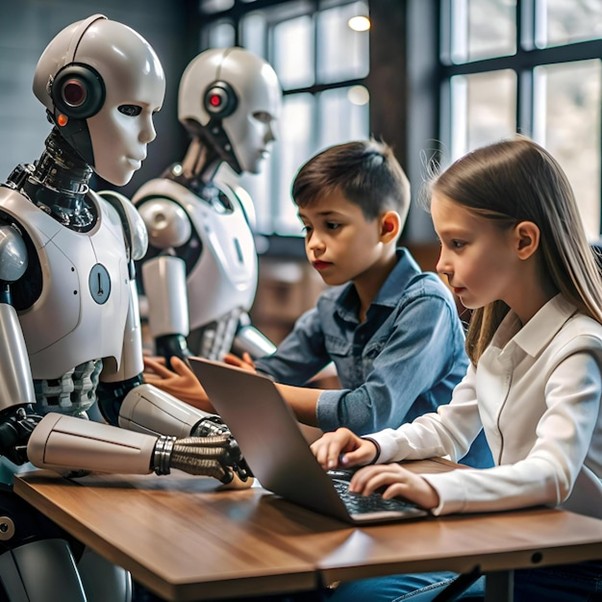
There is a quiet revolution unfolding in classrooms across the world. It does not arrive with the clang of factory machines or the smoke of industrial chimneys. It hums softly through fiber-optic cables and glows gently on laptop screens. Artificial Intelligence has entered the classroom, and with it has come both promise and unease.
In primary schools, children now interact with learning systems that adapt to their pace. A struggling mathematics student no longer waits for a red mark at the bottom of a test. Instead, the system adjusts in real time, offering extra practice where it detects confusion and moving ahead where confidence shines. In language classes, AI can translate, transcribe, and even help learners with reading difficulties follow along more easily. Teachers, freed from endless stacks of grading and administrative paperwork, are beginning to reclaim something precious: time. Time to engage. Time to mentor. Time to teach.
At universities, the transformation is even more visible. Professors use AI tools to generate case studies, simulate economic scenarios, analyse complex datasets, and support research at a pace that would have seemed unimaginable only a few years ago. Students, meanwhile, are navigating a new academic terrain where AI can draft essays, summarize journals, and brainstorm ideas in seconds. Institutions are scrambling to rewrite assessment models, rethinking what it means to measure knowledge in a world where information is instantly accessible.
But beneath the efficiency lies a deeper question. If AI can tutor, analyse, draft, translate, and even debate, what becomes of the human role? This is where the conversation shifts from technology to humanity.
Parents are not merely worried about whether their children will cheat using AI. They are worried about something far more existential. They worry about their own jobs. They worry about economic displacement. They worry that their children are being prepared for a future that may not have space for them. In countries like South Africa, where inequality already cuts deep, the fear is amplified. Those without digital access, without stable infrastructure, without quality education, risk being left even further behind in an AI-driven economy. And the concern is not irrational.
History tells us that automation does not eliminate work entirely, but it does transform it. Roles built on routine, repetition, and predictable processes are most vulnerable. Clerical positions, data entry, basic bookkeeping, standardized customer service, and even some forms of content production are increasingly handled by intelligent systems. The danger is not that there will be no jobs, but that there will be fewer jobs of a certain kind. Yet there is another side to this story, one less sensational and more nuanced.
AI excels at pattern recognition and scale. It processes data at breathtaking speed. But it does not possess lived experience. It does not feel responsibility. It does not navigate moral ambiguity with intuition shaped by culture, history, and emotion. The jobs most resilient in the age of AI are those that require complex judgment, emotional intelligence, creativity, ethical reasoning, leadership, and the ability to synthesize diverse human perspectives.
In education, this means a profound shift. Schools cannot simply add AI tools to old curricula. They must cultivate new literacies. Critical thinking becomes more important, not less. The ability to question an AI output, to verify its reasoning, to detect bias, to refine its prompts, and to understand its limitations becomes a foundational skill.
Universities are beginning to introduce AI ethics courses, interdisciplinary AI literacy programs, and collaborative projects that require human originality beyond algorithmic assistance. But policy and preparedness often lag behind adoption. Many educators feel undertrained. Many institutions are reactive rather than strategic.
This is where parents step into the frame. Parents cannot afford to either reject AI outright or surrender to it blindly. The wisest path lies between resistance and dependence. Children should be taught that AI is a tool, not a substitute for thought. They should learn to use it as a research assistant, a brainstorming partner, a coding companion, a language tutor. But they must also learn to think independently, to solve problems without automation, to debate without digital prompts.
If a child grows up understanding how to collaborate with AI rather than compete against it, that child enters adulthood with leverage instead of fear.
For teachers, the challenge is equally demanding. They must redesign assessment in ways that reward insight over regurgitation. Instead of asking students to produce information, educators must ask them to interpret, critique, and apply it. The classroom must evolve from a content delivery space into a thinking laboratory.
And for policymakers, especially in developing nations, the imperative is urgent. Infrastructure investment, digital literacy training, teacher upskilling, and equitable access are not optional extras. They are survival strategies. If only elite schools integrate AI meaningfully while underfunded institutions fall behind, the digital divide becomes a canyon.
There is also a broader cultural narrative to challenge. Some technology leaders speak of a future where automation creates such abundance that humans no longer need to work. It is a seductive vision. But for millions living on the economic margins, abundance without access is meaningless. The future cannot be left to market forces alone. It requires ethical stewardship.
The idea of a technological singularity, where AI surpasses human intelligence, fuels both excitement and anxiety. Yet singularity is not a single event; it is a gradual acceleration. Humanity has faced accelerations before. The printing press disrupted scribes. Electricity disrupted candle makers. The internet disrupted entire industries. Each time, the structure of work shifted, and each time, new roles emerged.
The difference now is speed. Speed demands preparation. So, what is the answer parents are searching for?
The answer is not to shield children from AI, nor to rush them uncritically into it. The answer is education reimagined as resilience training. Teach children how to learn continuously. Teach them adaptability. Teach them emotional intelligence. Teach them ethics. Teach them entrepreneurship. Teach them how to ask better questions than machines can anticipate.
And perhaps most importantly, teach them that technology amplifies human intention. If intention is narrow and extractive, AI magnifies inequality. If intention is inclusive and visionary, AI becomes a tool for upliftment.
In the end, the classroom of the future is not defined by screens or software. It is defined by the quality of guidance surrounding those tools. AI can personalize lessons, but it cannot model integrity. It can generate essays, but it cannot instill courage. It can optimize systems, but it cannot decide what kind of society we want.
Parents who fear job loss are right to demand foresight. But fear alone is not a strategy. Skill evolution is. Lifelong learning is. Community investment is. Collaboration between schools, universities, businesses, and governments is.
The age of AI is not the end of human relevance. It is a test of human adaptability. If we prepare wisely, this revolution does not marginalize humanity. It refines it.
Johan West is the CEO of FirstStepAI the author of the soon-to-be-released book The Eye of Creation, a thinker and writer exploring the intersection of technology, philosophy, and the evolving human story.