Ancient Trees That Refuse to Stand Still
There are trees that grow, trees that endure, and then there are trees that remember. The Araucaria family belongs firmly in the last category. These are not merely conifers; they are living relics of Gondwana, botanical time travellers whose ancestors shaded dinosaurs and watched continents drift apart.
The family Araucariaceae once spanned much of the ancient southern supercontinent. Today it survives in scattered strongholds across the Southern Hemisphere, with one extraordinary outlier hidden in the Blue Mountains of Australia. In total, the genus Araucariacomprises around nineteen recognised species, most native to Australasia, New Caledonia, South America, and a few Pacific islands. Each species carries a distinct architectural style, but all share an unmistakable presence: straight trunks, whorled branches, and an air of prehistoric authority.
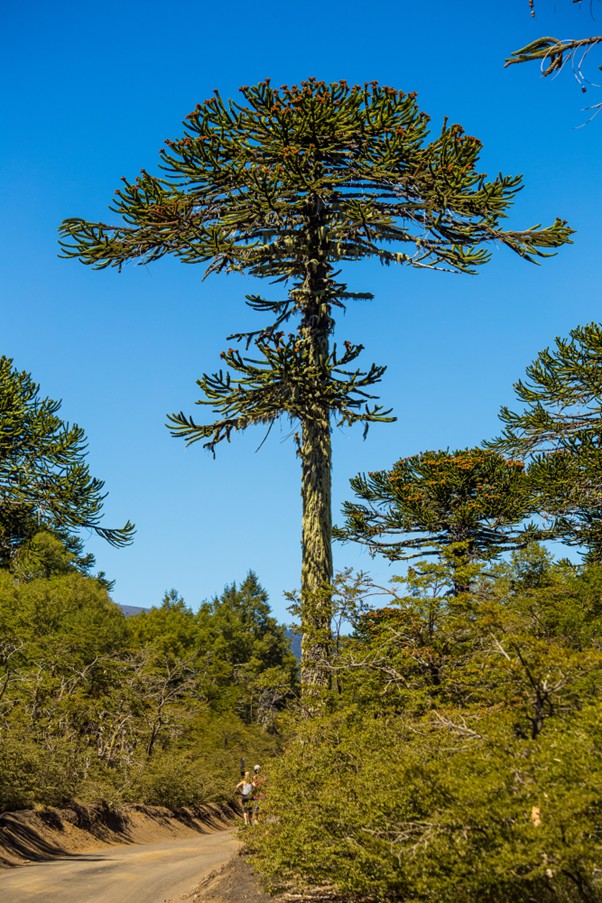
Among the most famous is Araucaria araucana, the Monkey Puzzle of Chile and Argentina, a tree so spined and armoured that Victorian gardeners joked even a monkey could not climb it. In Norfolk Island, the elegant Araucaria heterophylla became a maritime symbol, planted near ports across the British Empire as a living navigation marker. And then there is the near-mythical Wollemia nobilis, discovered only in 1994 in a secret canyon of Australia’s Blue Mountains, a species thought extinct for more than 90 million years.
But none of these quite prepare you for the quiet strangeness of the Cook pine.
The Tree That Leans With the Planet
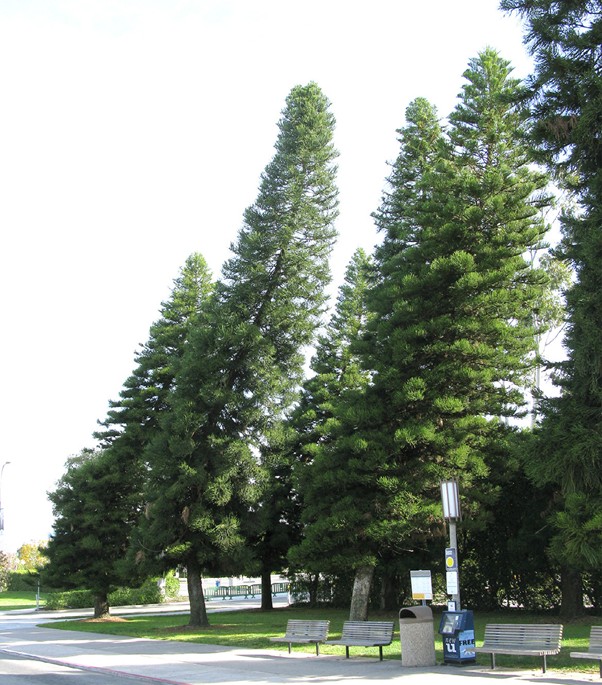
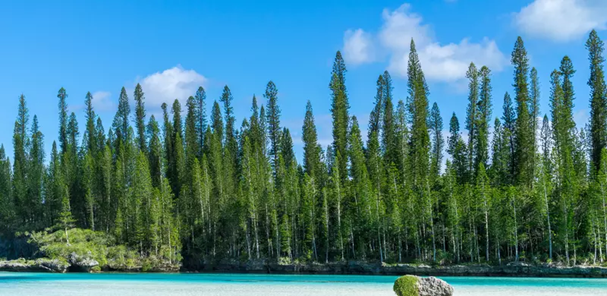
Araucaria columnaris, native to New Caledonia, looks at first glance like the most disciplined of trees. Its branches are short, symmetrical, almost geometric, forming a narrow green column that can reach 60 metres in height. Yet stand back, and something feels off. The trunk is not vertical. It never quite is.
In 2017, a global study measured 256 Cook pines across five continents. What emerged was one of the strangest growth patterns ever documented in trees. Wherever Araucaria columnaris is planted, it leans toward the equator. Always.
In the Northern Hemisphere, it tilts south. In the Southern Hemisphere, it tilts north. Near the equator, it grows almost perfectly upright, as if finally at peace. The average lean is just over eight degrees, roughly twice the tilt of the Leaning Tower of Pisa. In higher latitudes, especially southern Australia, some individuals lean at astonishing angles approaching forty degrees, yet continue to grow taller year after year without correcting themselves.
This alone sets the Cook pine apart. Most trees possess a powerful correction system known as gravitropism, a biological sense of gravity that straightens them as they mature. Even if young saplings bend toward the sun, adult trees usually re-align. Araucaria columnaris does not. It begins to lean, and then it commits.
Light, Magnetism, or a Genetic Memory?
Why does it do this? Science, for once, does not yet have a tidy answer.
One theory points to phototropism. At latitudes far from the equator, sunlight arrives at a sharper angle. By leaning equatorward, the Cook pine may be maximising annual light capture, especially during winter months. Another hypothesis suggests a sensitivity to Earth’s magnetic field, an idea that sounds exotic but is not entirely implausible; many organisms use magnetism as a spatial cue. A third explanation is more unsettling: a genetic quirk, a lost correction mechanism inherited from an ancient lineage adapted to a very different Earth.
What makes the mystery deeper is that other Araucaria species from New Caledonia do not behave this way. Planted in the same locations, they stand straight. Only Araucaria columnaris leans, as if following an instruction written long ago and never revised.
South Africa’s Borrowed Giants
South Africa, of course, is not the Cook pine’s home. Yet along the Western Cape, Garden Route, and KwaZulu-Natal coast, these trees have become quietly familiar. From Cape Town through Hermanus, Knysna, and north toward the Eastern Cape, they rise above old seaside gardens, hotels, and churchyards, often planted decades ago as ornamentals or windbreaks.
Their popularity makes sense. They tolerate salt spray, sandy soils, and strong coastal winds. They grow fast, live long, and demand little attention. Yet their presence raises an interesting ecological question. They are not indigenous, but neither are they aggressively invasive. In South Africa, Araucaria columnaris rarely spreads beyond cultivation. Its reproduction is slow, its seeds heavy, and its seedlings surprisingly particular.
Those seeds, however, deserve respect. The large, spiked cones can weigh several kilograms. Falling from forty or fifty metres, they are not merely a nuisance; they are dangerous. There are documented cases worldwide of serious injury, even death, from falling Araucaria cones. In gardens, these trees demand space and caution, a reminder that ancient species do not always adapt politely to suburban life.
Polynesian Lore and Silent Navigation
In its native New Caledonia, the Cook pine holds cultural significance for Kanak communities, where tall, straight trees were associated with ancestral presence and spiritual guardianship. Across Polynesia more broadly, Araucaria-like forms became markers in the landscape, guiding travel, ceremony, and memory. A tree that leans toward the equator, even subtly, would not have gone unnoticed by cultures attuned to wind, stars, and direction.
It is tempting, perhaps too tempting, to imagine these trees as living compasses, quietly acknowledging the shape of the Earth long before humans mapped it.
How Old Can They Get?
In cultivation, Cook pines commonly live 150 to 200 years, but in native conditions they may exceed that significantly. Their ancestors’ lineage stretches back over 200 million years. When you stand beneath one, you are not merely looking at a tree, but at a survival strategy refined across mass extinctions, ice ages, and planetary rearrangement.
A Tree That Refuses to Lie
In a world obsessed with straight lines, vertical growth, and neat explanations, Araucaria columnaris offers a gentle rebellion. It grows tall, but not obediently. It follows gravity, but not entirely. It respects light, magnetism, and latitude in ways we are only beginning to understand.
Perhaps that is its quiet lesson. Some truths are directional rather than absolute. Some growth is guided not by rules, but by relationship to the world around it.
And along the South African coast, as these borrowed giants lean ever so slightly north, they seem to whisper that the planet itself is still part of their story.
Johan West is the founder the GreenAfricaGroup, environmental consultants.