
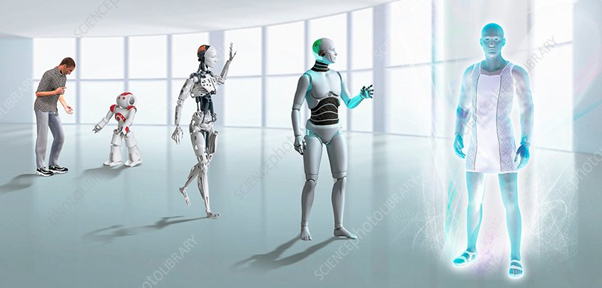
Humanity at the Edge of Its Next Becoming
There are rare moments in history when humanity senses, almost before it can articulate why, that it is standing near a threshold. Not merely on the verge of another invention, nor inside a passing cultural shift, but at the frontier of a transformation that may redefine what it means to be human. These moments are difficult to recognize while living through them. Only in hindsight do they acquire the clarity of turning points. Yet every so often, the signals gather with such density that even those inside the storm begin to feel the pressure change. Our age may be one of those moments.
Human beings tend to imagine progress as steady and linear, like footsteps along a predictable road. But the deeper record of civilization tells a very different story. Advancement rarely arrives smoothly. Instead, it moves in surges, long stretches of apparent stability interrupted by sudden accelerations so profound that the world afterward bears little resemblance to the one that came before. Anthropologists describe this rhythm as punctuated equilibrium: evolution lingering quietly for extended periods before leaping forward in bursts of radical change.
For tens of thousands of years, our ancestors lived as hunter-gatherers, their lives governed by the immediate demands of survival. Then agriculture emerged, and with it came the first great reorganization of human existence. Settlements replaced nomadic wandering. Surplus replaced scarcity. Soon afterward, writing appeared, allowing knowledge to outlive memory. Cities rose. Laws formed. Identity itself expanded from tribe to civilization.
Centuries later, another leap unfolded. The printing press shattered the monopoly of knowledge and ignited intellectual revolutions across continents. Electricity followed, extending human productivity beyond daylight and rewiring the tempo of daily life. The industrial age multiplied physical capability. The internet collapsed geography. And then, almost quietly at first, artificial intelligence entered the narrative.
Like the smartphone before it, AI is not simply another tool. It represents something more structurally disruptive. The smartphone placed the digital world into our pockets; artificial intelligence increasingly places expanded cognition within reach of our minds. For most of human history, tools amplified muscle. Now they begin to amplify thought itself.
Such moments invite an unavoidable question: are we merely inventing better instruments, or are we participating, knowingly or not , in the early formation of a new evolutionary chapter?
If history offers any guidance, it is that revolutions often appear gradual until suddenly they are undeniable. The early internet did not feel world-altering in its infancy. Nor did the first mobile devices hint at the psychological reshaping they would later bring about. We tend to underestimate exponential change because human intuition is wired for linear experience. It is like climbing a mountain in fog, the incline feels manageable until the clouds part and reveal how high one has already ascended.
Yet humanity does not move forward as a single organism. Multiple centuries coexist simultaneously on this planet. In one region, autonomous machinery navigates farmland using satellite precision. In another, communities cultivate soil with methods that would have been familiar thousands of years ago. Some children grow up conversing with intelligent systems; others grow up without reliable electricity.
This unevenness is not evidence of failure. It is the natural rhythm of civilization. Transformation spreads like weather, unevenly, unpredictably, sometimes resisted, sometimes accelerated.
For this reason, the coming decades may not produce one unified future, but several overlapping ones. We may witness populations living largely traditional biological lives alongside societies deeply integrated with technological augmentation. These would not necessarily be separate species in the biological sense, but they could represent profoundly different expressions of human experience.
Such a possibility often awakens an ancient narrative instinct, the idea that the “stronger” will inevitably displace the “weaker.” Yet history complicates that assumption. Neanderthals were physically stronger than Homo sapiens, more robust in harsh climates, formidable in ways we still admire. But strength alone did not determine the outcome. What distinguished sapiens was adaptability, the ability to cooperate flexibly, construct shared myths, transmit knowledge culturally, and reorganize behaviour in response to changing environments.
Adaptability, not dominance, has been evolution’s most reliable ally.
As humanity approaches a technologically amplified future, the decisive challenge will not be superiority. It will be integration. Can societies absorb rapid innovation without fracturing their moral and institutional foundations? Can technological acceleration coexist with psychological maturity? These are not merely engineering problems. They are civilizational ones.
The defining test of the coming century may therefore not be whether we can build increasingly powerful intelligence. Evidence suggests we already can. The deeper question is whether our wisdom will expand at a comparable pace. Intelligence enlarges capability. Wisdom governs direction. Without wisdom, intelligence becomes volatile. With wisdom, it becomes generative.
Encouragingly, despite humanity’s long catalogue of conflict, history also reveals a quieter pattern: cooperation tends to outlast chaos. If destructive impulses were truly dominant, civilization would have collapsed repeatedly beyond recovery. Instead, across centuries, societies have rebuilt, reorganized, and continued forward.
Good does not always win quickly. But it has demonstrated remarkable endurance. This should not lead to naive optimism. The future is never guaranteed. Yet neither is it something that merely happens to us. It is shaped, deliberately or inadvertently, by the posture with which we meet it.
Perhaps what is emerging is not the end of the human story, but the opening movement of a new chapter, one in which humanity must learn, more consciously than ever before, how to balance power with responsibility, expansion with restraint, and invention with reflection.
We stand, it seems, at the edge of our next becoming.
Part II, The Architecture of Humanity: Polarity, Integration, and the Future Shape of the Human Mind, will appear on 2 February 2026.
Johan West is the author of nonfiction and science fiction works that explore cosmology, consciousness, ancient knowledge, and humanity’s evolving relationship with the universe. His latest book, The Eye of Creation, examines the profound question of why existence itself is possible at all.