
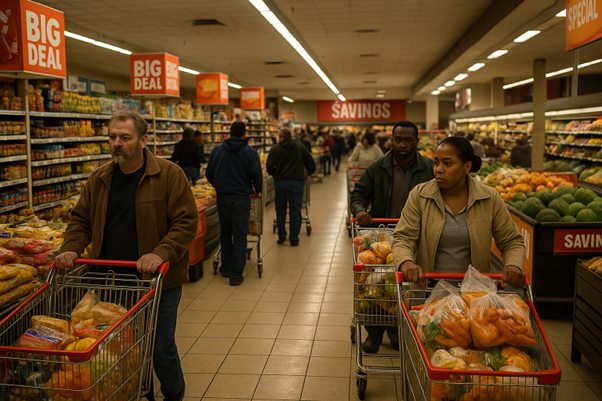
South Africa’s grocery giants entered the 2025 festive season with knives out and margins tight. What used to be a stable industry led by dependable household brands has now turned into a brutal war for market share. Shoprite, Woolworths, Pick-n-Pay and Spar are no longer just competing, they are fighting for survival, dominance, and investor trust.
With economic pressure tightening its grip on households and businesses alike, this is no longer a market for the weak. Load shedding costs, rising logistics expenses, political uncertainty, and a stagnant economy have squeezed retailers into a corner where growth no longer comes from new customers, but from stealing each other’s customers.
South Africa’s GDP per capita is lower now than it was 17 years ago. The average South African is poorer, real disposable income is under attack, and food inflation continues to outpace salary increases. That means only one thing:
Welcome to the Era of Supermarket Cannibalism where only the strongest brands will survive.
The Battle Lines Have Been Drawn
- Shoprite is crushing the competition with an aggressive expansion strategy, dominant logistics operations, and Africa’s most successful grocery app – Checkers Sixty60.
- Woolworths has fortified its premium turf, pulling higher-income shoppers away from rivals through consistent quality and brand trust.
- Pick-n-Pay is a turnaround story on life support – bleeding market share while desperately restructuring and banking its future on the Boxer chain.
- Spar is the silent struggler crippled by IT disasters, weak margins, and rising debt that threatens growth.
Retailers once grew alongside the South African economy. Those days are gone. Now they survive by taking territory from each other:
- Checkers steals from Woolworths
- Boxer steals from Shoprite and Pick n Pay
- Spar loses ground everywhere
Ask any South African investor, this sector is no longer a safe haven. It is a battleground.
South African Food Retailers – Financial Snapshot
| Company | Market Cap (R million) | Revenue (R million) | Net Income (R million) |
| Shoprite | R150,536 | R252,701 | R7,585 |
| Woolworths | R45,815 | R79,537 | R2,443 |
| Spar | R19,382 | R152,338 | R352 |
| Pick n Pay | R18,835 | R118,610 | -R736 |
Why This Matters Right Now
Christmas spending masks the true story. Beneath the festive lights and holiday shopping carts, only one of these four companies is truly profitable and built for future growth. The other three face structural risk. This is a critical moment for investors, portfolio managers, and anyone betting on the South African economy.
In this report, we answer three questions:
- Who is the most profitable retailer right now?
- Who has the best 5-year growth potential?
- Which retailer will survive a South African recession or rand crash?
Using real market data, including market cap, net income, P/E ratios, dividend yield, EPS trends, debt exposure and risk resilience I unpacked the real investment outlook behind each stock and compare the Big Four.
- Shoprite – the ruthless market leader
- Woolworths – premium profit fortress
- Pick-n-Pay – high-risk turnaround
- Spar – the fading contender
This is not just a grocery comparison. This is an investment reality check. Let’s break this down quickly and clearly so we can see which company is currently the most profitable and which one has the best future growth potential.
Profitability Comparison
To judge profitability, we look at net income (actual profit after expenses).
| Company | Net Income (R million) | Profitability Status |
| Shoprite | 7,585 | Strong Profit |
| Woolworths | 2,443 | Solid Profit |
| Spar | 352 | Very Low Profit |
| Pick n Pay | -736 | Loss-making |
Conclusion on profitability: Shoprite is by far the most profitable retailer in South Africa at the moment.
Growth Potential
Now let’s combine profitability with market position and expansion potential:
| Company | Growth Outlook | Notes |
| Shoprite | High | Strongest market share, expansion into Africa, OK Foods + Checkers Sixty60 dominate |
| Woolworths | Medium | Premium brand, stable but limited mass-market expansion |
| Spar | Low | Franchise model limits margin growth, struggling operations |
| Pick n Pay | High Risk/Turnaround | Currently losing money but may rebound under new strategy speculatively… |
Final Ranking
Best Current Profitability:
1. Shoprite – #1 by a long way
2. Woolworths – solid second
3. Spar – weak profit
4. Pick-n-Pay – financial trouble
Best Growth Potential:
1. Shoprite – continues to grow in Africa + digital retail
2. Woolworths – moderate upside via Woolies Food
3. Pick-n-Pay – risky turnaround play
4. Spar – limited growth strategy
Investment View
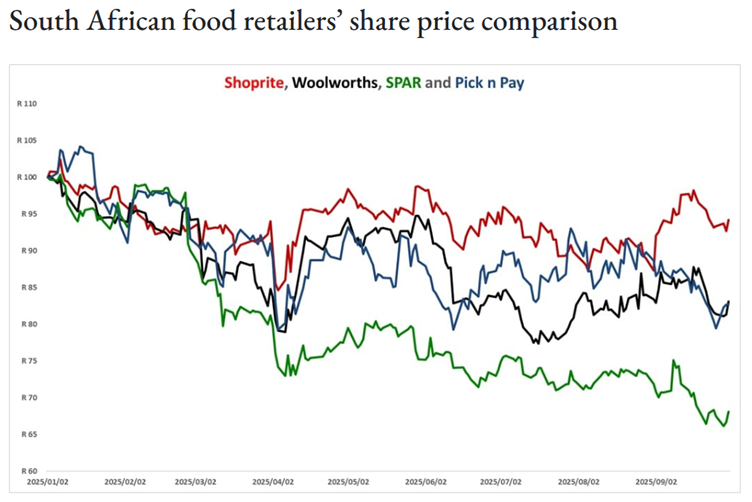
Graph credit: www.newsday.co.za
| Company | Investment Type | Risk Level |
| Shoprite | Long-term compounder | Low risk |
| Woolworths | Defensive, slow grower | Medium |
| Pick n Pay | Speculative recovery bet | High |
| Spar | Weak fundamentals | Medium/High |
Based on profit + growth Shoprite is the strongest by far – best margins, scale, innovation (Sixty60), and African expansion.
Valuation & Multiples
Shoprite
- The P/E ratio is about 20.6× (trailing) per recent data.
- Its forward P/E is lower, ~17.9× in recent estimates.
- Price-to-Sales (P/S) is ~0.60×.
- Price-to-Book (P/B) is ~5.0×.
- Debt / Equity is high: its “Total Debt / Equity (mrq)” is ~185.5 % (i.e. net debt is about 1.85× shareholders’ equity).
These suggest that the market expects strong future earnings growth from Shoprite, the multiple is not cheap, and it is quite leveraged (meaning debt amplifies both gains and risks).
Woolworths
- From their 2024 annual report, Woolworths has reduced its debt in recent years (sale of parts of the business reduced adjusted debt to ~ZAR10.3 b from ZAR27.4 b).
- Woolworths operates a premium / food + clothing model, with gross profit margins generally higher than mass-market grocers. This gives it better buffer and pricing power. (In comparisons between Woolworths Food vs Pick n Pay, Woolworths showed higher gross margin ~24.6 % vs ~18.5 % for PnP)
- However, I could not immediately find a recent P/E or forward multiple in my search result. (One would need to check a financial terminal or updated stock-data site.)
Given its lower debt and stronger margins, Woolworths tends to trade as a more stable, less aggressive growth play.
Pick n Pay
- The company is loss-making at present (net loss ≈ –R736 million in your earlier data), so the traditional P/E multiple is either undefined or negative (not meaningful).
- Recent news indicates that Pick-n-Pay is trying a turnaround / recapitalization. In their latest reports, the loss before tax narrowed significantly and they aim to break even by 2028.
- They have already done a rights issue to raise funds and reduce debt.
- Also, they are spinning off / boosting their discount chain, Boxer, which may carry higher growth potential.
So PnP is in a phase of financial restructuring, making its multiples more volatile and speculative.
Spar
- Spar’s financials show troubles: in its half-year results, earnings fell, and no dividend was declared due to cost pressures and interest costs.
- Its leverage is also high: “Total Debt / Equity (mrq)” ~247 %.
Spar is under pressure, especially from cost inflation, interest rates, and operational issues (e.g. IT systems).
Margins, Returns & Capital Efficiency
Beyond simple profit, we want to know whether the profits are efficient (good returns), and whether growth can be funded sustainably.
- Shoprite, being profitable, likely has positive returns on equity / capital. Its high P/B suggests investors believe its returns are above cost-of-capital.
- Woolworths, with its premium brand, tends to have healthier margins in its food & clothing mix, which can help it maintain returns even in tougher times.
- Pick n Pay’s challenge is that when revenues fall or costs rise, the losses hit deep – turnaround will require restoring margins, controlling debt costs, and perhaps focusing on higher-margin segments (Boxer, clothing, etc.).
- Spar’s struggles with cost inflation and system issues show that margins are under squeeze; its ability to maintain or improve margins is uncertain.
Strategic Growth Levers & Risks
Shoprite
Levers:
- Geographic expansion into Africa (outside South Africa) with more potential markets.
- Digital and logistics investments (e.g. e-commerce, home delivery).
- Efficiency gains via scale and supply chain optimization.
- Brands (Checkers, etc.) allowing targeting different segments.
Risks:
- Currency risk and foreign exposure in weaker African markets.
- Debt burden: if interest rates rise, servicing debt becomes costlier.
- Competition & margin pressure (food retail is low-margin by nature).
- Economic downturn in South Africa, inflation, load shedding, supply chain disruptions.
Woolworths
Levers:
- Brand premium gives pricing power, especially in food & fashion sectors.
- International operations in some markets may provide diversification.
- Expansion of food operations, more “food-led” growth could have higher margins.
Risks:
- Fashion / clothing divisions can be volatile, sensitive to consumer sentiment.
- Currency / cost inflation.
- Competition both from discount grocers and premium players.
Pick n Pay
Levers:
- The turnaround is the main lever – if they can stabilize operations and become profitable again.
- Growth via Boxer / discount retail, which may have a higher growth trajectory.
- Debt restructuring to reduce interest burdens.
Risks:
- If turnaround fails, further losses / insolvency risk.
- Execution risk is high – many moving parts.
- Market share loss to more efficient competitors.
- Reliance on raising capital / debt markets (if they can access funding).
Spar
Levers:
- Strengthen operational efficiency, fix IT / distribution issues.
- Expand in regions / locations with growth potential.
- Cost control to offset inflation.
Risks:
- High debt / leverage tilt risk.
- Margin compression from cost pressures (fuel, energy, inflation).
- Weakness in core business segments.
This deeper dive generally reinforces that Shoprite is currently the strongest candidate, but with caveats:
- Its multiples are not cheap, so much of its “goodness” is already priced in.
- Its leverage is high, so it’s more vulnerable to interest rate increases, currency issues, or earnings stress.
- Among the peers, Woolworths looks like a safer “defensive premium” candidate. It probably offers lower upside but less downside risk.
- Pick-n-Pay is a high-risk, high-reward turnaround. If the turnaround succeeds, gains could be substantial, but if not, losses may continue.
- Spar seems less attractive given its current struggles and high leverage.
Current Base Data Snapshot
| Company | P/E (TTM or latest) | Dividend Yield | Current issues / notes |
| Shoprite | ~ 20.5× to ~24× depending on source | ~ 2.7 % – 2.8 % | Earnings up ~15.8 % last year; sold non-core businesses; expanding delivery & logistics. |
| Woolworths | ~ 19.6× (current) ; forward P/E ~ 13.98× | ~ 3.6 % div yield | Premium brand / fashion-food mix; payout ratio is high (~ 83 %) |
| Pick n Pay | Negative (loss-making) ; forward P/E ~ 38× | 0 % (no dividend) | Undergoing recapitalization, rights issue, restructuring |
| Spar (SPP) | No clearly positive P/E data | Dividend yield ~ 0 % (no dividend declared) | Facing cost, IT, margin pressures, withheld dividend |
Forecast Model Outline & Assumptions
Here’s is a few scenario forecasts:
Key Assumptions
| Factor | Conservative | Balanced | Aggressive |
| EPS growth (annually) | 2 % – 4 % | 5 % – 8 % | 10 % – 15 % |
| Dividend growth | 1 % – 3 % | 3 % – 6 % | 6 % – 10 % |
| P/E multiple change (re-rating) | no expansion, maybe contraction | stable multiple | modest expansion |
| Risk factors penalty | modest deductions for debt, load shedding, rand weakness | normal allowances | minimal discounting |
| Capital returns / buybacks | low | moderate | higher |
I’ll also run a stress / extreme scenario: sharp rand collapse, deep recession, political instability, which will impose heavy earnings compression, P/E de-rating, dividend cuts.
5-Year Forecast
Below is a simplified forecast table for 5 years, showing share price growth + dividends = total return under each scenario. (These are illustrative and based on the above assumptions.
- Base share price = 100 (normalized starting point)
- Dividends reinvested in each year
- Final total return = share price growth + reinvested dividends (approx.)
| Company / Scenario | Conservative (5y) | Balanced (5y) | Aggressive (5y) | Stress Scenario (5y) |
| Shoprite | +30 % | +70 % | +130 % | –20 % |
| Woolworths | +25 % | +60 % | +110 % | –25 % |
| Pick n Pay | –40 % | +20 % | +80 % | –60 % |
| Spar | –20 % | +10 % | +50 % | –40 % |
- Under Conservative, only Shoprite and Woolworths show modest gains (driven by stable dividends + slow growth).
- Under Balanced, Shoprite leads, Woolworths next, Pick-n-Pay recovers, Spar lags.
- Under Aggressive, Shoprite is a strong winner; Pick-n-Pay recovers strongly; Woolworths does well too.
- Under Stress scenario, most lose – only maybe Woolworths with its premium brand might hold some relative resilience, but even it likely dips.
10-Year Projection Sketch (Preliminary)
- Shoprite: Balanced: +300 % to +400 % over 10 years (x3–x5)
- Woolworths: Balanced: +200 % to +300 %
- Pick n Pay: Balanced: could go +100 % to +200 % if turnaround succeeds
- Spar: Balanced: +50 % to +150 % (modest)
- In stress, many could end up flat or negative, perhaps –50 % to –70 % for weaker ones.
Risk Ratings & Sensitivity
- Shoprite: Medium risk – highest debt, exposure to Africa & rand volatility, but strong execution & brand.
- Woolworths: Lower-medium risk – premium brand, better margin buffer, less aggressive leverage.
- Pick n Pay: High risk – turnaround dependent, very sensitive to execution errors & funding.
- Spar: High risk – weak margin, structural / operational pressures, no dividend cushion.
In extreme scenarios, companies with negative margins (Pick n Pay, Spar) are more vulnerable to bankruptcy, dividend cuts, capital erosion. The bottom line is I were to pick one to hold over the long term (10 years+), I’d lean Shoprite, balancing profitability, growth levers, and market confidence. Woolworths is my safer “sleep-at-night” alternative. If I want a speculative bet, I might back Pick n Pay’s recovery path – but only with a small portion of my capital.
Johan West is the CEO of www.firststepconsult.com