
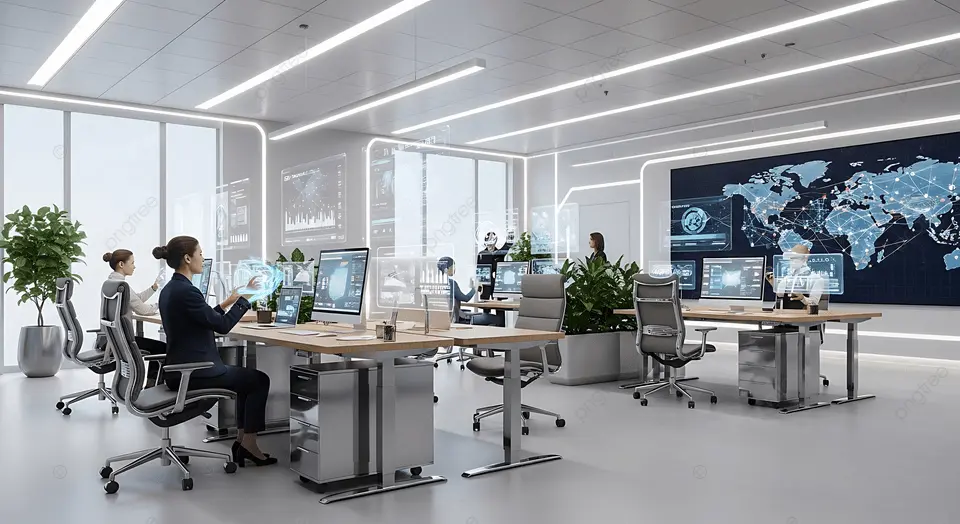
There is a quiet but profound reshaping of the modern workplace unfolding before us, not with the noise of industrial machines or the visible sweep of globalisation, but through lines of code, algorithms, and invisible digital agents. Artificial intelligence is no longer a distant promise whispered in research labs; it is here, embedded in boardrooms, offices, farms, and even in the palms of our hands. And as it arrives, it is not merely changing jobs, it is redefining what work itself means.
A recent shift among major global companies offers a glimpse into this transformation. Firms like Meta and Block are rethinking traditional corporate hierarchies, experimenting with flatter organisational structures where layers of middle management are reduced or reimagined. In some cases, managers are becoming “player-coaches,” expected to contribute directly alongside their teams, while AI systems take on parts of coordination, analysis, and decision support. The symbolism here is striking. For decades, organisations were pyramids. Today, they are becoming networks.
This is not simply a managerial trend. It is a structural response to a deeper technological shift. Artificial intelligence has reached a point where tasks that once required entire teams can now be performed by a single skilled individual equipped with the right tools. Coding, data analysis, design, marketing strategy, even elements of legal and financial work, are increasingly augmented, accelerated, or partially automated by AI systems. The result is a compression of effort. What once took ten people may now take three. What once took months may now take days.
And yet, beneath this efficiency lies a tension that many feel but struggle to articulate. If AI can do more, where does that leave the human?
History offers a useful lens. Every major technological revolution has displaced certain forms of labour while creating others. The industrial revolution replaced manual artisans but gave rise to factories and engineering disciplines. The digital revolution eliminated clerical roles but created entire industries in software, cybersecurity, and global communications. AI is simply the latest chapter in this long narrative of disruption and renewal.
But there is something different this time. Previous technologies replaced physical effort. AI encroaches on cognitive territory. It does not just lift heavier loads; it thinks, predicts, writes, and learns. This creates a more intimate challenge. It touches the very skills people have spent decades cultivating.
Yet it would be a mistake to view AI purely as a rival. It is more accurate, and far more empowering, to see it as an amplifier.
Consider the emerging idea of the “augmented professional.” This is not a person replaced by AI, but one who is enhanced by it. A consultant who uses AI to analyse complex datasets in minutes. A farmer who uses predictive models to optimise irrigation and crop yield. A writer who collaborates with AI to refine ideas and structure narratives. In each case, the human remains central, but their reach is extended dramatically.
This is where the real opportunity lies. The individuals who will thrive in this new landscape are not those who resist AI, but those who learn to work with it fluently. They will not ask, “How do I protect my job from AI?” but rather, “How do I use AI to become exceptional at what I do?”
The shift we are witnessing in companies reinforces this idea. As hierarchies flatten, decision-making becomes more decentralised. Employees are expected to think, act, and innovate with greater autonomy, often supported by AI tools rather than guided by layers of oversight. This demands a different kind of worker. Less passive, more proactive. Less dependent, more adaptive.
But this transformation is not without risk. Removing structure entirely can lead to confusion, lack of accountability, and inefficiency. Past experiments in “self-management” have shown that humans still need clarity, leadership, and shared purpose. AI can assist, but it cannot replace the human capacity for judgement, empathy, and ethical decision-making. Even the most advanced systems lack the lived experience that shapes wisdom.
There is also a deeper societal question at play. If AI continues to increase productivity while reducing the need for certain roles, how do we ensure that opportunity remains widely distributed? How do we avoid a future where efficiency benefits a few while leaving many behind?
The answer, at least in part, lies in education and mindset. The skills that will matter most in the coming decades are not purely technical, though those are important. They are human skills. Creativity, critical thinking, emotional intelligence, adaptability, and the ability to learn continuously. These are not easily automated. In fact, they become more valuable in a world where routine tasks are handled by machines.
For individuals, the path forward is both simple and demanding. Embrace lifelong learning. Experiment with AI tools. Become curious about how they work and how they can enhance your field. Do not wait for change to arrive at your doorstep; step into it deliberately.
For organisations, the challenge is to balance efficiency with humanity. To use AI not merely as a cost-cutting tool, but as a means to empower people, unlock innovation, and create more meaningful work. The companies that succeed will not be those that remove humans from the equation, but those that elevate them.
And perhaps, at the end of it all, the most important shift is philosophical.
For centuries, work has been closely tied to identity. We define ourselves by what we do. But if AI begins to take over more tasks, we may be forced to ask a deeper question. Are we defined by our output, or by our capacity to think, create, and connect?
In a world where machines can perform many of our functions, what remains uniquely, irreducibly human?
The answer to that question may shape not only the future of work, but the future of society itself.
Johan West is the CEO of FirstStepAI, a forward-thinking platform focused on practical AI integration and innovation, and the author of the soon-to-be-released The Eye of Creation, a work exploring the intersection of science, philosophy, and the evolving role of humanity in a rapidly changing world.