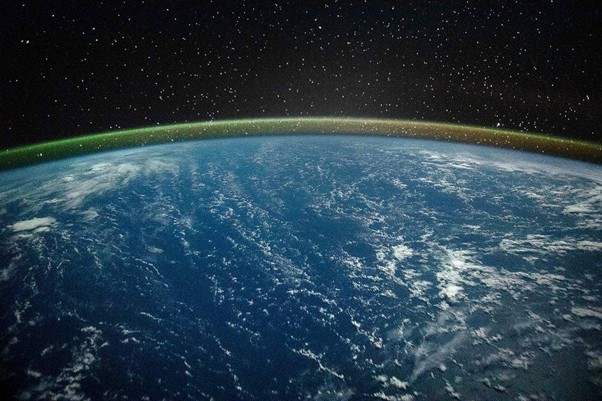
There is a moment, somewhere between Earth and the infinite, where perspective breaks open like a shell. From orbit, our world does not argue. It does not fragment into nations, ideologies, or grievances. It simply exists. A luminous, breathing sphere wrapped in a veil so thin it almost feels accidental, like a whisper clinging to a planet. This is what astronauts return with, not just photographs, but a quiet, unsettling truth.
When Ron Garan looked down from the International Space Station, he did not see geopolitics. He saw systems. Lightning storms dancing across continents without passports. Ocean currents moving heat like invisible arteries. Auroras spilling green fire across the poles, indifferent to who owned what below them. And most haunting of all, he saw the atmosphere, not as the sky we take for granted, but as a fragile, paper-thin membrane, a life-support system so delicate that, from space, it appears almost implausible.
This is the “overview effect,” a term coined by Frank White, describing the cognitive shift experienced by those who witness Earth from beyond it. It is not poetic exaggeration. It is neurological recalibration. Astronauts return changed, often struggling to reconcile the unity they saw with the divisions they return to.
Decades earlier, another voice captured this truth in a way that still echoes. When Carl Sagan reflected on the image taken by Voyager 1, he described Earth as a “pale blue dot,” suspended in a sunbeam, a fraction of a pixel in the vast cosmic arena. His words were not sentimental. They were surgical.
“Look again at that dot,” he wrote. “That’s here. That’s home. That’s us.” Everything humanity has ever loved, fought for, believed in, or destroyed exists within that single, fragile point of light. And yet, here we are.
While satellites drift silently above us, mapping the pulse of the planet in real time, down below, conflict continues with a stubborn, almost tragic persistence. The current tensions involving Iran, the strategic manoeuvring of the United States, and the broader instability across the Middle East unfold as though the Earth were infinite, as though consequences could be contained, as though the system we all depend on were not shared.
From orbit, this illusion collapses instantly. There are no “regional” consequences in a closed system. Atmospheric circulation does not pause at borders. Ocean chemistry does not negotiate treaties. A destabilised region sends ripples through energy markets, migration patterns, food systems, and global stability. The Earth does not recognise “us versus them.” It only responds to inputs.
This is not philosophy. It is systems science. The planet operates as a tightly coupled network of feedback loops. Carbon cycles, hydrological cycles, energy balances, biodiversity networks. Disrupt one, and others respond. Amplify enough disturbances, and the system begins to behave unpredictably. Not out of malice, but out of mathematics.
And yet, our priorities often remain inverted. Garan’s simple hierarchy, planet first, society second, economy last, is not an ideological statement. It is a structural reality. An economy is not an independent entity. It is a subsystem embedded within society, which itself is embedded within the biosphere. Remove the foundation, and everything above it collapses.
It is astonishing that such a basic truth still requires articulation. Perhaps the reason is that we have never truly seen ourselves from the outside. Not collectively. Not in a way that forces a recalibration of identity. We still think like inhabitants of land, not crew members of a vessel.
Because that is what Earth is. A spacecraft.
Not metaphorically, but functionally. A closed-loop system travelling through space at roughly 107,000 kilometres per hour around the Sun, carrying over eight billion passengers, each dependent on the same air, the same water, the same thin shield of atmosphere. There is no resupply mission. No emergency exit. No second Earth waiting in orbit.
And yet, many still behave as if someone else is responsible for maintaining the systems. This is where the timing of Earth Day 2026 becomes more than symbolic. For the first time in history, humanity stands at the edge of two converging revolutions. One outward, one inward.
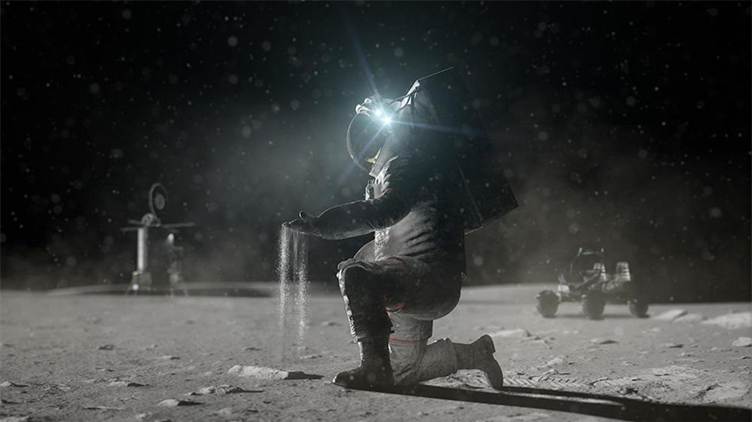
Outward, we are returning to the Moon. Through Artemis program, humanity is not merely revisiting the lunar surface. It is laying the groundwork for a sustained presence beyond Earth. The successful missions, including the uncrewed Artemis I, have already demonstrated the capability to send spacecraft deeper into space than any human-rated system in decades. The upcoming missions aim to place humans back on the Moon, not for flags and footprints, but for permanence. Habitats. Infrastructure. A stepping stone to Mars.
For the first time, the idea of becoming a multi-planetary species is transitioning from speculation to engineering. At the same time, inward, another revolution is unfolding. Artificial intelligence. Not as a tool, but as an amplifier of human capability. Systems that can process planetary-scale data, model climate interactions, optimise energy systems, design new materials, and even assist in governance and decision-making. AI has the potential to become the nervous system of this planetary spacecraft, integrating signals from every subsystem into coherent, actionable insight.
We are, quite literally, evolving the capacity to understand and manage our world at the scale it demands. And yet, the contradiction remains.
We are building the tools to explore other worlds while struggling to manage our own. We are designing habitats for the Moon while destabilising the one biosphere we already inhabit. We are advancing toward a future of interplanetary civilisation while still entangled in conflicts that, from orbit, appear not just tragic, but irrational.
This is the tension of our time. Not between nations, but between perspectives. The ground view and the orbital view. From the ground, differences dominate. History, identity, territory, belief. From orbit, those differences dissolve into patterns of light and shadow, into systems interacting, into a single, continuous whole.
The challenge of Earth Day is not simply to raise awareness. Awareness, at this point, is abundant. The challenge is to internalise a different perspective without needing to leave the planet. To think like astronauts while standing on the ground. To see borders as administrative constructs rather than existential divisions. To understand that economic systems are tools, not goals. To recognise that conflict within a closed system ultimately degrades the system itself.
This does not mean abandoning complexity or pretending that geopolitical realities do not exist. It means contextualising them within a larger framework. A framework where survival, stability, and long-term flourishing depend on cooperation at a planetary scale.
Because whether we acknowledge it or not, we are already operating as a single civilisation in a single system. The question is whether we will act like it. Sagan’s pale blue dot was not a warning. It was an invitation. An invitation to maturity. To step beyond tribal instincts and into planetary consciousness.
Garan’s overview effect is not reserved for astronauts. It is accessible to anyone willing to reframe their perspective. To look at Earth not as a collection of problems, but as a single, interconnected system that requires stewardship.
And perhaps that is the quiet, urgent message of this moment. We do not need to wait for catastrophe to force unity. We have the knowledge. We have the technology. We have the vantage point, even if only through images and data.
What we lack is alignment. Earth Day 2026 arrives at a crossroads. Behind us, decades of warnings, discoveries, and incremental change. Ahead of us, the possibility of a radically different trajectory, one where humanity chooses to act as a coherent system rather than a fragmented collection of competing interests.
From orbit, the path is obvious. There is no “over there.” There is no “them.” There is only this small, radiant, improbable world, carrying all of us through the dark. And the longer we pretend otherwise…the harder that truth will become.
Johan West, founder of Green Africa Group, is an environmentalist, strategist, and thinker whose work centres on the interconnected nature of planetary systems and humanity’s place within them. In his forthcoming book, The Eye of Creation, he explores the origins of life, the structure of the universe, and the delicate conditions that make existence possible, blending scientific insight with philosophical depth to suggest that humanity’s greatest challenge is not a lack of knowledge, but a misalignment of priorities, and that we are not separate from the system we inhabit, but an intrinsic part of it.