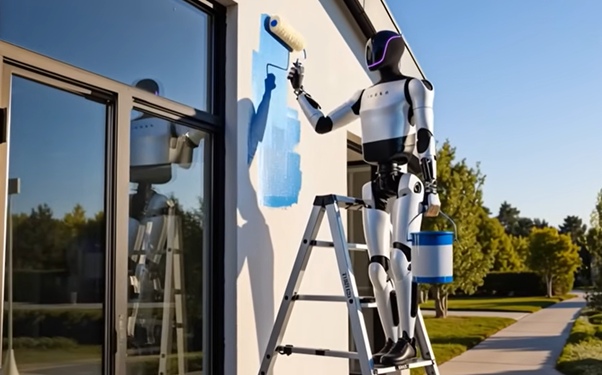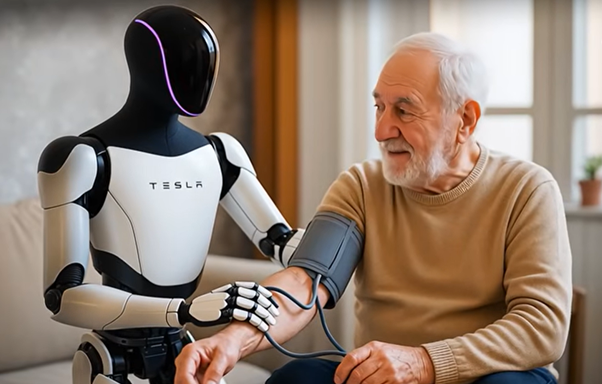
There are moments in history when a technology quietly steps out of the laboratory and into everyday life, and only later do we realise that everything has changed. The motor car did this in the early twentieth century, the smartphone did it at the start of the twenty-first, and in 2026 another threshold is being crossed. This is the year robots stop being curiosities and start becoming companions, co-workers and helpers, moving naturally among human populations with the same casual familiarity we now reserve for vehicles on the road.
For years, robotics has dazzled us with spectacle. Machines that can backflip, box, dance or play table tennis have filled social media feeds, particularly from China, where dozens of manufacturers are now producing increasingly capable humanoid platforms at remarkable speed and scale. These demonstrations are impressive, but they are not the real story. The real question is no longer how fast a robot can move or how strong it can be. Those benchmarks have already been surpassed. The question that truly matters, and the one reshaping the entire market in 2026, is far more human: can a robot walk into an ordinary home, understand what it sees, and do something genuinely useful without being micromanaged step by step?
This is where the narrative shifts from novelty to inevitability, and where one product in particular looms large. The arrival of Tesla Optimus Generation 3 marks a decisive change in direction for humanoid robots. Rather than focusing on choreographed tricks, the emphasis moves to learning, adaptation and usefulness. The idea that a robot can learn by watching video, practising in simulation and then transferring that knowledge into the messy, unpredictable real world has sent a quiet tremor through the robotics industry. It challenges decades of assumptions about how machines should be programmed and controlled.
For most of their history, robots have been powerful but fragile. They thrived inside factories, behind safety cages, in environments engineered precisely for them. Change the lighting, move an object a few centimetres, introduce a human behaving unpredictably, and the system would fail. Homes are the opposite of factories. Kitchens are chaotic, tools are improvised, surfaces are cluttered and people rarely do the same task in exactly the same way twice. Designing a robot that can cope with this reality is vastly harder than teaching one to repeat a perfect movement on a production line.
According to Elon Musk, Optimus Gen 3 is designed precisely for this challenge. Scheduled to debut in 2026, it is expected to perform around 3,000 genuinely useful tasks, from cooking and cleaning to assisting with personal care, at a price point that brings it within reach of households and small businesses rather than only large corporations. More striking still is Musk’s confirmation that this is not the end of the road. Tesla is already planning mass production of Generation 4 and Generation 5, suggesting a rapid, iterative path where capability doubles and reliability approaches human-level accuracy within a surprisingly short time frame.
Much of the attention has focused on Optimus’s hands, described by Musk as almost “magical”, and for good reason. Human hands are extraordinary machines, combining strength, delicacy and sensory feedback in a compact form. Replicating even a fraction of this capability has long been one of robotics’ greatest obstacles. Optimus Gen 3 reportedly uses dozens of miniature motors, tendon-like cable systems and fingertip sensors capable of detecting pressure and temperature, allowing it to grip a fragile glass, chop vegetables or handle laundry without crushing or dropping items. These are small details, but they are the details that make the difference between a robot that looks impressive and one that is actually welcome in a home.
The deeper breakthrough, however, lies not in hardware but in learning. Instead of being explicitly programmed for every scenario, Optimus is designed to learn by observation. It can watch instructional videos, rehearse tasks millions of times in simulated environments, fail safely, improve, and then apply that knowledge in the real world. Crucially, what one robot learns can be shared across the entire network. When a single unit masters a new task, that capability can propagate instantly to others, creating a form of collective learning that no human workforce could ever replicate.
This has profound implications for daily life. In ageing societies, particularly across Europe, Japan and parts of Africa, elder care is fast becoming one of the defining social challenges of the coming decades. Robots capable of assisting with mobility, reminding people to take medication, monitoring for falls or hazards, and offering simple companionship could dramatically ease pressure on families and healthcare systems. These machines are not replacements for human care or empathy, but they can fill gaps, reduce loneliness and provide practical support where human resources are stretched thin.
Beyond the home, the applications multiply quickly. Domestic chores such as cleaning, gardening and shopping assistance are obvious starting points, but the same platforms can be deployed in hospitals, hotels, warehouses and offices. Security robots patrolling the perimeter of a property, agricultural robots tending crops or monitoring livestock, and medical robots assisting nurses with routine tasks all move from speculative concepts to commercially viable solutions in 2026. Over time, these machines will become as commonplace as service vehicles, quietly performing work in the background while humans focus on creativity, decision-making and care.
There is, inevitably, a philosophical undercurrent to this shift. Every major wave of automation has sparked fears of job displacement, and robotics is no exception. History suggests, however, that while certain roles change or disappear, new industries and forms of work emerge. In the near term, humans will remain more flexible and economical for many tasks. Robots will first take on repetitive, dangerous or physically demanding work, extending human capability rather than replacing it outright. The real challenge will be managing the transition thoughtfully, ensuring that the benefits of automation are widely shared rather than narrowly concentrated.
By the end of 2026, it will feel entirely normal to see robots moving through human spaces, interacting politely, performing useful tasks and learning continuously. What once belonged to science fiction will have become infrastructure. For individuals and businesses alike, the question will no longer be whether robots have a place in society, but how best to integrate them.
This is where platforms such as www.firststeprobots.com come into play. As a one-stop destination for robots of all kinds, from humanoid androids designed for companionship and care, to industrial, medical, agricultural and security robots capable of patrolling and protecting property, First Step Robots positions itself at the centre of this emerging ecosystem. Installation, integration and practical deployment matter just as much as the machines themselves, and the market is rapidly maturing to meet those needs.
The year of the robot has arrived, not with a bang, but with a steady, confident step into our everyday lives. And once they are here, walking beside us rather than behind factory fences, there will be no going back.
Johan West is the CEO of FirstStepRobots and the author of this article.
Visit our shop at www.firststeprobots.com/shop/