
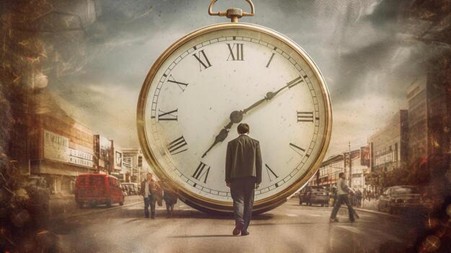
It is 2026. A new number on the calendar, a fresh page in the diary, and for many of us an unsettling feeling that 2025 barely had time to leave footprints before it vanished. One moment we were making plans, the next we were counting down again. We joke that time is flying, that the years are accelerating as we age, but beneath that familiar complaint sits a deeper, stranger question. What if time itself is not what we think it is?
We experience time as an unstoppable river. Seconds drip into minutes, minutes swell into years, and everything we love, build, or lose is carried along by that current. Yet modern physics quietly disagrees with this comforting picture. According to Einstein’s theory of relativity, time is not a universal clock ticking the same for everyone. It is a dimension, woven together with space into a single fabric called spacetime. Move faster or sit closer to a massive object like a planet or a black hole, and time itself stretches and slows. Two clocks, once synchronised, can drift apart simply because they took different journeys through the universe.
This alone should make us pause. If time can stretch and bend, perhaps it is not the solid, marching force we imagine. Some physicists go further, suggesting that time is not fundamental at all. At the deepest level of reality, the equations that describe the universe work just as well forwards as backwards. They do not care about past or future. The flow of time, they argue, may be something our brains construct in order to make sense of change.
In this view, the past, present, and future all exist at once. Every moment of your life, your birth, this sentence, the last day you will ever see a sunset, is already part of the universe’s structure. What we call “now” is simply our consciousness sliding along a fixed timeline, like a needle tracing the grooves of a vinyl record. We feel movement, but perhaps nothing is actually moving at all.
It is a disquieting idea. If the story is already written, are we living, or merely watching? Yet before that thought becomes too heavy, step outside into the warmth of a Southern Hemisphere summer. It is school holiday time. Children are barefoot on the beach, their skin salty, their laughter louder than the surf. They are building sandcastles with absolute seriousness, shaping towers and walls as if these structures might last forever. For a brief while, they do.
But leave the castle alone. The wind rises, the tide creeps closer, a careless foot passes by. Grain by grain, the walls soften and slump until the castle returns to what it always was, a simple pile of sand. This gentle, everyday scene hides one of the most profound ideas in science, one that explains why time seems to move in only one direction.
In the 19th century, engineers trying to improve steam engines stumbled into deep questions about heat, energy, and efficiency. Their practical concerns gave birth to thermodynamics, and with it emerged a concept that would quietly redefine our understanding of time itself: entropy. Entropy is a measure of disorder, or more precisely, a measure of how many different ways a system can be arranged while still looking the same.
A pile of sand has high entropy. There are countless ways to shuffle its grains without changing its overall shape. A sandcastle, by contrast, has low entropy. Its beauty depends on a very specific arrangement of grains. Almost any change will destroy its structure. Nature, left to itself, moves from low entropy to high entropy, from order to disorder. This is the second law of thermodynamics, and it is astonishingly powerful.
There is nothing in the fundamental laws of physics that forbids the wind from spontaneously assembling a sandcastle out of a pile of sand. In principle, it could happen. In practice, it never does, because it is overwhelmingly unlikely. There are vastly more ways for sand to be disordered than ordered. And so entropy increases, relentlessly.
This statistical tendency explains why we remember the past but not the future, why eggs break but do not unbreak, why we grow older but never younger. It gives time its arrow. Not because the laws of physics demand it, but because probability does.
Now shift scenes again, from a sunny beach to the frozen edge of the world. Imagine standing in Antarctica, or on the great glaciers of Patagonia that feed into the Southern Ocean. From a distance, these immense rivers of ice appear timeless, as fixed and eternal as the mountains. Up close, they are alive with motion. Ice creaks and cracks. Millions of tons break free and collapse into the sea each day. What looks static is, in fact, constantly changing.
This slow violence carries a message about time that feels uncomfortably relevant in 2026. Glaciers flow because events occur in sequence. Snow falls, compresses into ice, inches downhill, and eventually melts. These events always happen in the same order. They never run backwards. We never see shattered ice leap from the ocean, reassemble itself, and climb back onto the glacier. The laws of physics allow it in theory, but entropy forbids it in practice.
Climate change adds another layer to this story. As global temperatures rise, ice melts faster, oceans expand, and coastlines shift. The arrow of time becomes visible in our environment, written in retreating ice fronts and rising sea levels. These changes are not undone. They accumulate. They remind us that the passage of time is not just a philosophical puzzle, but a lived, physical reality with consequences.
And yet, there is a strange comfort in this irreversibility. If everything could run backwards, nothing would matter. Joy and tragedy gain their weight precisely because they cannot be replayed. We age, we love, we lose, and we remember. Permanent change is not a flaw in the universe; it is what gives our lives texture and meaning.
So as 2026 unfolds, perhaps the question is not whether time is flying, or whether it even exists in some ultimate sense. Perhaps the better question is how we choose to inhabit our small slice of it. Whether time is an illusion or an emergent property of entropy, our experience of it is real enough. The children on the beach feel it in their laughter. The melting ice records it silently. Our bodies carry its mark, year by year.
We may be passengers on a timeline already laid out, or authors writing as we go. Physics has not yet given us a final answer. But standing at the beginning of a new year, one thing is clear. The arrow of time is pointing forward, and we are moving with it, whether by choice or by chance. The only real freedom may lie in how attentively we live each moment as it passes, or perhaps, as it simply is.
And so, as 2026 begins, may we live a little more consciously within the time we are given, attentive to change, open to possibility, and kind to the world and to one another. Wishing you all that is truly wonderful in 2026.
Johan West is an author and thinker, writing across non-fiction and science fiction.